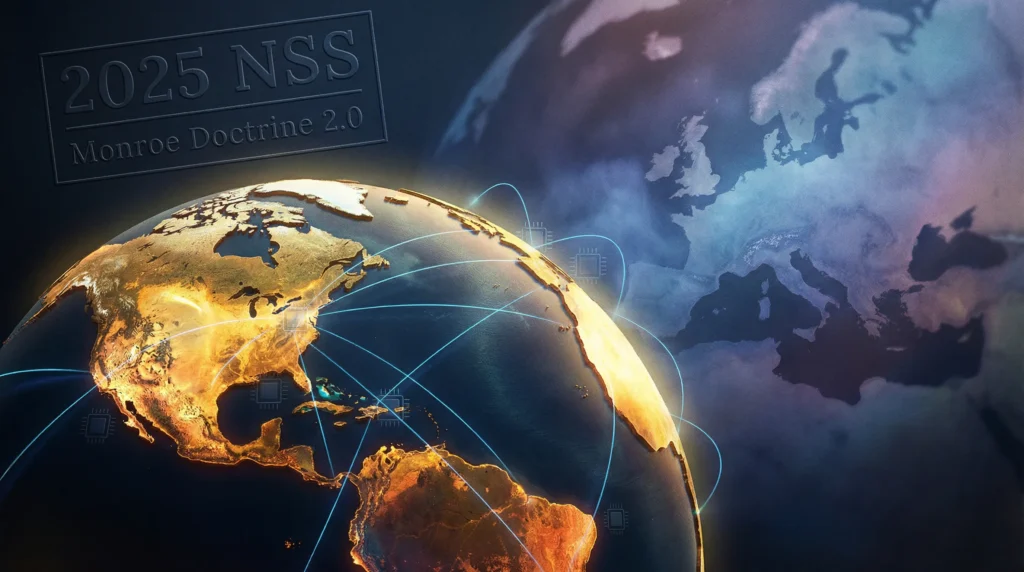

With the release of the 2025 National Security Strategy (NSS) and the Trump Corollary to the Monroe Doctrine, the United States has executed the most dramatic foreign‑policy pivot in decades. Together, these documents redefine the logic of U.S. global engagement -and reshape how global trade, alliances, and supply chains will be organized going forward.
One of the most consequential changes: The old “three‑bucket” worldview has been replaced by a new four‑bucket hierarchy – and Europe is the region placed into the newly created bottom tier.
Another under‑examined signal: U.S. actions in Venezuela may have less to do with narcotics and more to do with telling China and Russia to leave the Western Hemisphere.
Below is how these pieces fit together-and why 2026 is poised to be a transformational year.
1. From 3 Buckets to 4: The Biggest Strategic Reordering in a Generation
Trump’s first term introduced a three‑bucket model and we have seen it play out in 2025:
- Preferred Allies
- Competitors/Opponents
- Everyone Else
The 2025 NSS replaces that structure with a sharper, more hierarchical four‑bucket system:
Bucket 1…Western Hemisphere Preferred Partners
The Americas become the center of U.S. economic and security strategy. Near‑shoring, migration control, and regional manufacturing lead the agenda.
Bucket 2…Strategic Necessity Allies
Japan, South Korea, Canada, Mexico. Not always aligned ideologically — but indispensable to U.S. strategy.
Bucket 3…Adversaries
China, Russia, and BRICS states. Framed as systemic threats requiring economic and strategic containment.
Bucket 4…Declining Partners (Europe)
This is the shock. The NSS describes Europe as facing:
• demographic decline • “civilizational erasure” • loss of national identity • political instability • weakening military readiness
It warns Europe could be “unrecognizable in 20 years.”
For the first time since WWII, Europe is no longer central to American strategy.
2. The Trump Corollary: Monroe Doctrine 2.0
On December 2, the administration announced the Trump Corollary to the Monroe Doctrine, declaring:
“The American people…not foreign nations nor globalist institutions will always control their own destiny in our hemisphere.”
This represents a 21st‑century adaptation of the Monroe Doctrine with four priorities:
• hemispheric supply‑chain realignment • migration and border control • counter‑narcotics and maritime security • pushing rival powers out of the Americas
It signals a shift from global commitments to regional primacy.
3. Venezuela: The First Real Test of the New Doctrine
The administration’s moves in Venezuela are widely discussed as counter‑narcotics or humanitarian policy.
But strategically, Venezuela is much more than that.
It is:
• Russia’s largest intelligence and logistics foothold in Latin America • China’s biggest oil‑backed lending asset in the region • an expanding BRICS energy node • a geopolitical beachhead in the Caribbean basin
Viewed through the Trump Corollary, Venezuela becomes the first real enforcement action of the new Monroe Doctrine:
China and Russia do not get a free hand in the Western Hemisphere.
This is less about narco‑terrorism-and more about a hemispheric eviction notice.
4. Europe’s Move to Bucket 4: Why It Matters
The NSS openly doubts Europe’s:
• military capacity • economic durability • demographic future • political stability • long‑term ability to contribute to U.S. strategy
It even suggests the U.S. should “cultivate resistance” inside European nations…supporting nationalist/patriotic movements instead of EU institutions.
This moves Europe from being a global co‑pilot to a region the U.S. views as strategically secondary.
5. How the Four‑Bucket World Reshapes Global Trade and Supply Chains
Western Hemisphere…The Primary Beneficiary
Expect:
• accelerated near‑shoring • expanded Latin American manufacturing corridors • more bilateral trade deals in the region • capital flows shifting toward the Americas
This aligns perfectly with Bucket 1.
Strategic Necessity Allies…Negotiated but Stable
Japan, South Korea, Canada, and Mexico remain critical supply‑chain pillars. Expect tactical conflict…but strategic continuity.
China/BRICS…Deepening Fragmentation
Expect:
• extended tariffs • tech and energy export controls • forced supply‑chain diversification • expanded financial decoupling
The divide will deepen.
Europe…The Biggest Uncertainty
European manufacturers face:
• reduced U.S. prioritization • a widening regulatory split • capital leaving the continent • weakening transatlantic industrial alignment
Europe is no longer the assumed U.S. partner.
The Big Question
Does this four‑bucket architecture define the next decade…or is it simply the foundation for a much more hemispheric grand strategy?
And if Europe continues sliding into Bucket 4, how long before even strategic allies like Japan and South Korea feel pressure to orient more tightly around the Americas?
Many are troubled by the disruption of norms, the downgrading of long‑standing alliances, and the willingness to challenge seventy years of institutional continuity. But if the goal is a pure America First strategy, should any of this be surprising?
Is this a targeted, surgical restructuring of global alignment? Or the start of a much deeper re‑ordering where geography outranks ideology and alliances become fully transactional?
And as 2026 unfolds, a new question is emerging:
If 2025 gave us a Monroe Doctrine revival and a four‑bucket world, what comes next…a hemispheric alliance architecture? A regional economic bloc? A formal Americas‑first compact?
Some are already whispering a phrase that would have sounded impossible a decade ago:
The Mar‑a‑Lago Accords. A Western Hemisphere economic and security framework built not in Brussels or Geneva, but in Palm Beach.
My final question: How do your supply chain strategies align with this new world order?
I help companies small and large on mitigating tariff exposure and broader supply chain strategies…taking actionable steps to give you greater confidence on a logical path forward.
Book a call….
https://supplychainalytics.ai/contact
Sign up for my newsletter…
https://supplychainalytics.ai/blog/#newsletter
Tariff Refund‑Rights Preservation Checklist
I built a one‑page checklist covering:
• Liquidation tracking • PSC timing • protest rules • documentation for scrutiny • transfer pricing alignment • weekly broker review • economic‑burden proof requirements
Download here: https://supplychainalytics.ai/refund-rights-preservation-checklist/
Protect your rights. Prepare for scrutiny. Position your company to win the next era of tariffs.