
Markets are fixated on tariff refunds and court cases. The real story is structural: Mexico, Europe, and a hemisphere-wide realignment are quietly closing the doors on a $1+ trillion surplus — regardless of what the Supreme Court decides.
While markets obsess over potential tariff refunds and Supreme Court rulings, they’re missing the bigger story.
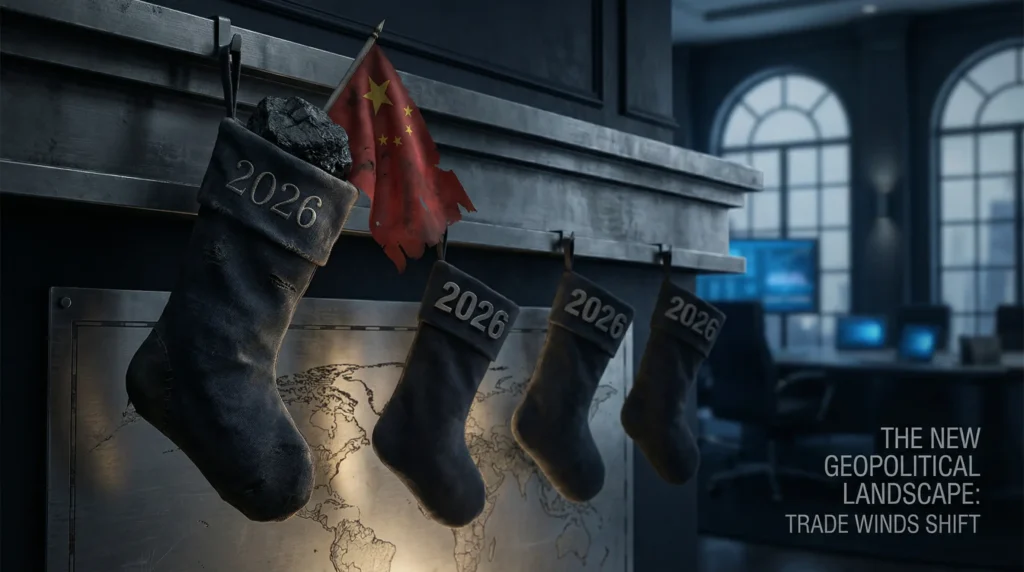
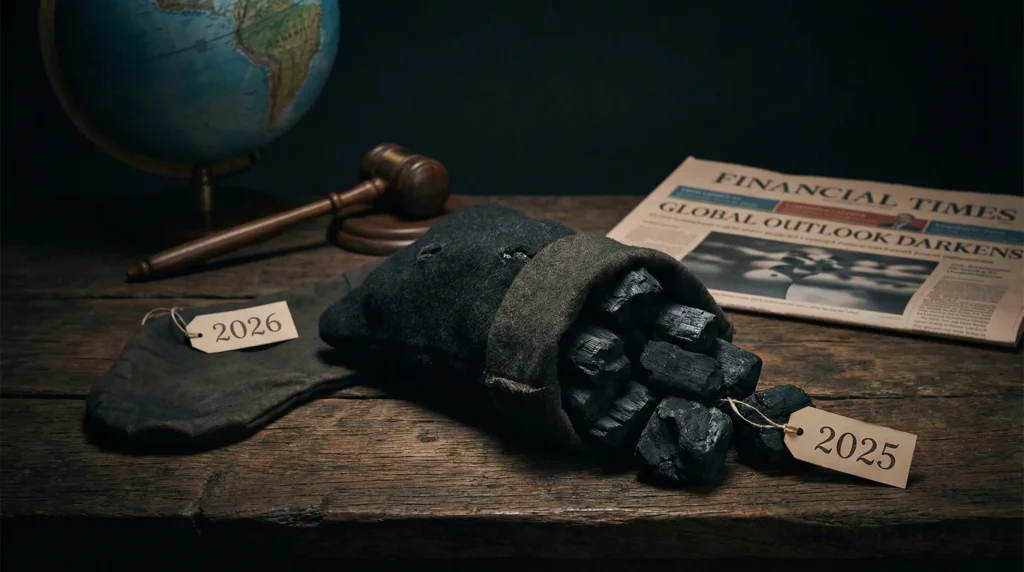
China got coal in its stocking for 2025. In 2026, the stockings are empty.
Not because of a U.S. court decision — but because the world has quietly decided it is done absorbing a $1+ trillion Chinese trade surplus.
The $1 Trillion Paradox
China’s trade surplus reached roughly $1.07 trillion through November 2025, up more than 20% year over year.
That figure is often treated as evidence of strength. It isn’t.
Surpluses of that magnitude signal structural imbalance, not dominance.
China exports more than four times what it imports from the United States. With Mexico, the ratio approaches 13:1. France’s bilateral deficit with China climbed toward €47 billion, while the EU’s overall deficit surged sharply in 2025.
These aren’t reciprocal trade relationships. They function as extraction systems.
And systems like that don’t get renegotiated indefinitely — they eventually get shut down.
Everyone Is Acting…Without Coordination
This isn’t a U.S-led campaign against China.
Countries aren’t copying Washington. They’re independently arriving at the same conclusion as Chinese exports are redirected into their economies.
In 2025, China offset an 18% decline in exports to the U.S. by flooding other markets:
- Europe: +9%
- Southeast Asia: +15%
- Africa: +27%
That worked…briefly.
Now those doors are closing.
Mexico (December 2025): Approved 5–50% tariffs on more than 1,400 products from non-FTA countries, explicitly targeting China. Effective January 1, 2026. Legislative. Durable.
Europe: French President Emmanuel Macron warned that without action, Europe would be forced to “decouple, like the U.S.,” describing the moment as existential for European industry.
No coordination. No grand alliance.
Just identical conclusions reached separately.
This isn’t just about tariffs…it’s about where capital is being allowed to go.
2026: Six Acts, Empty Stockings
The fixation on roughly $138 billion in potential U.S. tariff refunds is a sideshow. Here’s what actually restructures trade in 2026.
Act 1: The Supreme Court Sideshow (Q1 2026)
Markets are betting the Supreme Court strikes down IEEPA-based tariffs.
Even if that happens:
- Claims must be filed within 180 days
- Documentation and pass-through analysis are required
- Reviews and appeals stretch 12–24 months
Meaningful refunds don’t arrive until 2027–2028.
By then, the system is already rebuilt.
Act 2: The Tariff Pivot (Q1–Q2 2026)
If IEEPA falls, tariffs don’t disappear…they migrate.
The administration has made clear that alternative authorities are ready:
- Section 232 national-security tariffs
- Section 301 China investigations launched in late 2025
- Section 122 — an emergency authority dormant for decades but still legally available
The legal mechanism may change. The trade posture does not.
Act 3: Mexico Goes Live (January 1, 2026)
Mexico’s tariffs take effect immediately…up to 50%.
Mexico was the largest global market for Chinese autos in early 2025. That door just closed.
These tariffs are legislative. Reversal requires Congress.
This stocking is empty.
Act 4: Europe Acts (Q1–Q2 2026)
Europe’s trade deficit with China has ballooned, driven in part by exports diverted from the U.S.
The WTO now projects near-zero global trade growth in 2026, explicitly citing fragmentation and tariffs.
Europe doesn’t need U.S. court rulings to act.
It needs survival.
Act 5: The Congressional Reckoning (Mid-2026)
The USMCA joint review concludes in July 2026.
If IEEPA is curtailed earlier in the year, Congress faces choices it has avoided for decades:
- Whether tariff authority remains executive or becomes legislative
- Whether tariff revenue becomes structurally embedded in fiscal policy
- Whether trade frameworks require formal ratification
Canada remains insulated…too embedded in North American energy, auto, and critical-minerals supply chains to exclude.
The question isn’t rates.
It’s governance.
Act 6: Hemispheric Realignment (All of 2026)
As China’s stockings disappear, new ones are being hung — and they’re being filled with capital, not just trade preferences.
Trade follows investment. And investment is already choosing sides.
The Trump administration claims it has secured approximately $18 trillion in direct foreign investment commitments tied to U.S. and hemispheric production, infrastructure, energy, and advanced manufacturing.
Whether one accepts the full headline number or discounts it materially, the directional signal matters:
Capital is being explicitly incentivized and politically protected inside the hemisphere.
That pull is accelerating bilateral deals and physical build-out:
- U.S.–Mexico trade approaching $1 trillion
- Expanded bilateral frameworks across Latin America
- Canada doubling down on energy, critical minerals, and advanced manufacturing
- Infrastructure approvals turning into actual ports, rail, power, and logistics execution
This isn’t theoretical nearshoring.
It’s concrete, steel, and balance sheets.
Meanwhile:
- Japan and South Korea increasingly align investment with hemisphere-oriented supply chains
- India remains complex but strategically unavoidable
- Brazil hedges…maintaining China ties while shifting incremental investment westward
What’s happening isn’t a clean break.
It’s progressive decoupling — deal by deal, factory by factory, port by port.
The sorting mechanism isn’t ideology.
It’s where capital feels protected.
The Bottom Line
2025: China got coal — a surplus that exposed an unsustainable export-dependence model.
2026: The stockings are empty.
Not because of courts — but because:
- Mexico legislated tariffs
- Europe chose survival
- Capital flowed into the hemisphere
- Bilateral deals multiplied
- Infrastructure moved from approvals to construction
- Decoupling became operational
Markets are watching refund checks in 2027–2028.
Smart money is watching January 2026, Q1–Q2 2026, and July 2026.
China got coal for Christmas in 2025. In 2026, the stockings are empty — regardless of what the Supreme Court says.
The only real question:
Which stocking is your supply chain hanging from?
I help companies mitigate tariff exposure and build confidence in a logical path forward.
Book a call:
https://supplychainalytics.ai/contact
Sign up for my newsletter:
https://supplychainalytics.ai/blog/#newsletter
Refund-Rights Preservation Checklist
I built a one-page checklist covering:
- Liquidation tracking
- PSC timing
- Protest rules
- Documentation readiness
- Transfer pricing alignment
- Weekly broker review
- Economic-burden proof requirements
Download:
https://supplychainalytics.ai/refund-rights-preservation-checklist/
Protect your rights. Prepare for scrutiny. Position your company to win the next era of tariffs.