

The escalating tension between America’s economic leverage and the Global South’s quest for financial independence
The geopolitical chess match between the United States and the rapidly expanding BRICS alliance has intensified dramatically in 2025, with President Trump deploying an increasingly aggressive tariff strategy to defend the dollar’s supremacy. As Trump announced an additional 10% tariff on countries that orient themselves along the “Anti-American policies of BRICS,” the stakes in this economic standoff have never been higher.
BRICS: From Acronym to Global Force
What began as a Goldman Sachs marketing term in 2001 has evolved into a formidable coalition representing nearly half the world’s population. BRICS now accounts for 35-40% of global GDP (measured by purchasing power parity), though only about 28-29% when measured by nominal GDP. The bloc’s expansion strategy has been particularly aggressive, with Indonesia officially joining as the tenth member in January 2025, while nine other nations have been officially designated as “partner countries.”
Full Members (10 total):
- Original five: Brazil, Russia, India, China, South Africa
- 2024 additions: Egypt, Ethiopia, Iran, UAE
- 2025 addition: Indonesia
Partner Countries: Algeria, Belarus, Bolivia, Cuba, Kazakhstan, Malaysia, Nigeria, Thailand, Turkey, Uganda, Uzbekistan and Vietnam
Notable Holdouts: Saudi Arabia’s invitation remains undeclared—the kingdom has neither accepted nor rejected its invitation, while Argentina withdrew under President Milei’s administration.
The Fractured Foundation: Why Each Nation Joined and Internal Conflicts
Understanding the underlying motivations reveals a coalition built more on shared grievances than common goals, with fundamental contradictions that limit effectiveness.
Divergent Dreams of the Original Five
China: Wishes to accelerate American decline and position BRICS in opposition to the West as part of its ambition to dethrone the U.S. as sole global hegemon.
India: Faces a complex balancing act, navigating membership in both the US-led QUAD alliance (with Australia and Japan) and BRICS. This dual alignment creates constant tension—allied with both the US (against China in the Indo-Pacific) and with China (against the West in BRICS).
Russia: Initially convened the group driven by Putin’s desire to create a Western counterweight, but following Ukraine’s invasion has become desperate for allies and increasingly dependent on China.
Brazil: Reluctant to expand, preferring the original five-member structure. As current BRICS chair, Brazil’s Western-friendly leadership will likely diverge from Russia’s anti-Western direction.
South Africa: Serves as the gateway to Africa but maintains strong sympathies for Russia despite closer ties with India.
Alliance of Enemies: When Members Are Adversaries
The most serious structural problem is that several BRICS members harbor genuine animosity toward each other. The China-India border dispute persists despite tactical agreements, with 24 soldiers killed in the 2020 Galwan Valley clash. Saudi Arabia and Iran bring their bitter regional proxy wars directly into BRICS. Egypt and Ethiopia remain locked in an increasingly hostile dispute over the Grand Ethiopian Renaissance Dam.
As Jim O’Neill, who coined the original BRIC acronym, noted: “I will take the BRICS group seriously when I see signs that the two countries that really matter – China and India – are actually really trying to agree on things, rather than effectively trying to confront each other all the time.”
What unites BRICS is less a positive agenda than shared dissatisfaction with the Western-dominated international order. This negative cohesion creates operational paralysis—at a foreign ministers’ meeting in September 2024, leaders couldn’t even agree on UN Security Council reform. China accounts for more than half the bloc’s economic might, creating inherent imbalance.
Trump’s Economic Doctrine: Beyond Dollar Defense
Trump’s tariff strategy serves multiple interconnected objectives revealing a comprehensive economic doctrine:
The Administration’s Goals Now Become Clear
- Trade Deficit Elimination: “Drive bilateral trade deficits to zero” after 2024’s $1.2 trillion deficit
- Reindustrialization: “Better-paying American jobs making beautiful American-made cars, appliances, and other goods”
- Revenue Generation: Tariffs will raise $156.2 billion in 2025, the largest tax hike since 1993
- Dollar Reserve Currency Defense: Maintaining the dollar’s role as the world’s primary reserve currency, providing the US with “exorbitant privilege”—the ability to borrow in its own currency, export inflation, and maintain massive trade deficits without immediate consequences
The Three-Bucket Country Classification System
Trump’s trade advisors have long referred to a “three-bucket” framework for categorizing countries based on their relationship with the United States, a strategy that was discussed even before the administration took office. This systematic approach to trade policy helps explain what might otherwise appear as inconsistent tariff actions across different nations.
Bucket 1 – Strategic Allies/USMCA Partners: Countries like Canada and Mexico that, despite temporary tariff threats, maintain preferential access through existing trade agreements. These nations face targeted pressure on specific issues (border security, drug interdiction) rather than systematic trade restructuring.
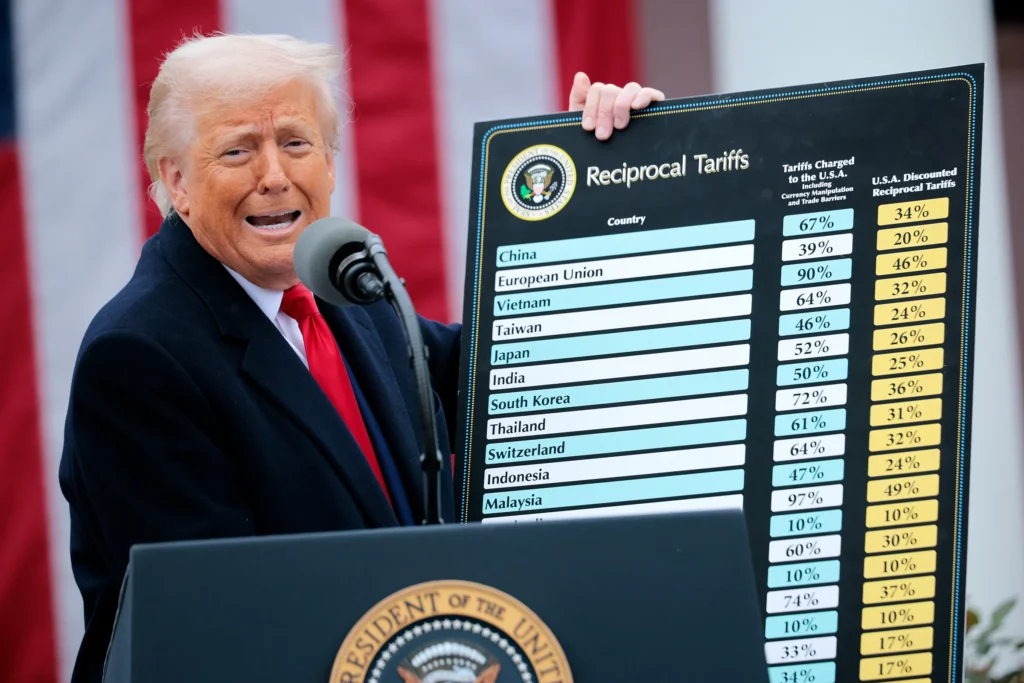
Bucket 2 – Reciprocal Tariff Nations: Countries facing “individualized reciprocal higher tariff” based on their bilateral trade deficit with the US. This includes major economies like the EU, Japan, and others where the administration seeks to “follow the golden rule on trade: Treat us like we treat you”.
Bucket 3 – Strategic Competitors/BRICS+: Nations like China, Russia, and Iran facing maximum tariff pressure (up to 100%) combined with broader economic and technological decoupling efforts. These countries are viewed as fundamental threats to the US-led economic order.
Trump’s Escalating Tariff Arsenal
The 100% BRICS Currency Threat: “We are going to require a commitment from these seemingly hostile Countries that they will neither create a new BRICS Currency, nor back any other Currency to replace the mighty U.S. Dollar or, they will face 100% Tariffs.”
The 10% Alignment Penalty: Additional tariffs on countries aligning with “Anti-American policies of BRICS”
Targeted Country-Specific Measures: Varying rates up to 40% based on bilateral negotiations
Multiple Perspectives on Trump’s Approach
The Strategic Leverage View
Many applaud Trump’s efforts as effectively using America’s remaining economic levers. Supporters argue he’s:
- Using market access leverage while it still exists (58% of global reserves)
- Exploiting BRICS internal contradictions before potential consolidation
- Forcing countries to choose between BRICS alignment and US market access
- Acting decisively rather than passively accepting American decline
“Access to the American market is a privilege, not a right.”
The Economic Reality Check
Critics point to contradictions:
- Deficit Paradox: $3.4 trillion tax cuts conflict with deficit reduction goals
- Jobs vs Revenue Conflict: Households face average $1,183 tax increase from tariffs
- Reindustrialization Challenge: US industrial share declined from 50% to 12% since 1950s
The Self-Defeating Argument
Research shows by the end of Trump’s term, GDP is $432 billion lower and prices 1.6% higher. Critics argue Trump’s aggressive defense could accelerate the very de-dollarization trends it seeks to prevent.
The Dollar Under Siege: Two Critical Threats
Despite dollar dominance (58% of global reserves), structural challenges are accelerating:
The Great Central Bank Gold Rush
Central banks purchased a staggering 1,045 tonnes of gold in 2024—the third consecutive year above 1,000 tonnes. Key buyers: Poland (90 tonnes), Turkey (75 tonnes), India (73 tonnes), China (44 tonnes reported).
Crucially, 43% of central bankers plan to increase gold reserves (record high) while 73% expect reduced dollar reserves over five years.
The Bilateral Trade Revolution
Trade increasingly settles in local currencies with gold as final settlement rather than dollar accumulation:
- China-Russia trade reaching $147 billion, 25% in yuan-ruble
- India-Malaysia settling trade in rupees
- India’s energy trade with Russia in rupees/rubles
When countries don’t want volatile local currencies, they’re turning to gold—creating dual threats to dollar usage and demand.
The Supply Chain Revolution: Reglobalization in Real Time
This is reglobalization, not deglobalization—companies are rebuilding global trade along new geopolitical lines.
The New Trade Geography…see any similarities to the other buckets?
- Western Sphere: US, EU prioritizing security and shared values
- BRICS+ Network: Integrated around China, Russia, local currencies
- Swing States: India, Brazil, Gulf nations playing multiple sides
Four Pillars of Reglobalization
1. Friend-Shoring Over Efficiency: Geopolitical reliability trumps cost optimization
2. Currency Bloc Economics: Regional currency settlement replacing dollar transactions
3. Technology Iron Curtains: Semiconductors, AI, green energy flowing within blocs but not between them. Technology decoupling maintains US leverage over potential de-dollarizers.
4. Infrastructure Weaponization: Sanctions cutting countries from SWIFT triggered alternatives—Russia’s SPFS connects 159 foreign entities across 20 countries, China’s CIPS processes $12.8 trillion annually. BRICS Pay aims to unify these networks.
The Time Horizon Reality
This transformation unfolds over years, not months:
- Years-long transitions rebuilding manufacturing networks
- Permanent dual systems serving different blocs
- Skills shortages as complexity explodes…AI might not gap fill
- Capital intensity increases as redundancy becomes strategic necessity
The supply chains built in the next five years will determine competitive advantage for the next two decades.
Strategic Implications for Business Leaders
- Supply Chain Diversification: Reduce tariff-sensitive route exposure
- Currency Risk Management: Prepare for emerging market volatility and gold appreciation
- Market Access Contingency: Develop trade fragmentation strategies
- Geopolitical Intelligence: Monitor BRICS expansion and US responses
- Alternative Settlement Tracking: Follow local currency agreements and gold settlement trends
- Reserve Asset Allocation: Consider central banks’ pivot toward gold
Three Scenarios Ahead
Scenario 1: Successful Deterrence – Trump’s threats discourage BRICS currency initiatives, maintaining dollar dominance
Scenario 2: Accelerated Decoupling – Countries reduce US dependencies through alternative payment systems and reserve diversification
Scenario 3: Pragmatic Coexistence – Both sides moderate positions—BRICS pursues gradual local currency usage, US moderates tariff threats
Conclusion: The New Cold War Economics
The battle represents a fundamental contest over global financial architecture. While a BRICS currency remains unlikely, the underlying trends—central bank gold accumulation, bilateral trade in local currencies, infrastructure weaponization—pose genuine long-term challenges to dollar dominance.
The most concerning development isn’t the headline-grabbing BRICS currency, but the quieter revolution in central bank vaults and trade settlements. When major economies systematically reduce dollar reserves while increasing gold holdings, and trade settles in local currencies backed by gold rather than dollar accumulation, dollar hegemony’s foundation erodes.
Trump’s aggressive defense could accelerate the very trends it seeks to prevent. Whether America’s financial empire follows historical patterns of overusing privileged position may depend on how skillfully—or recklessly—it wields remaining economic weapons.
The coming months will reveal whether Trump’s tariff gambit represents strategic brilliance or strategic overreach. But one thing is clear: the era of unquestioned dollar supremacy faces its most serious challenge since Bretton Woods nearly eight decades ago.
The battle lines are being drawn now. Countries and companies positioning effectively during this reglobalization will capture disproportionate benefits. Those stuck in pure efficiency optimization risk being left behind in a world where geopolitical alignment determines market access.
What are your thoughts on Trump’s tariff strategy? Effective defense of American interests or counterproductive acceleration of fragmentation? Share your perspective below.