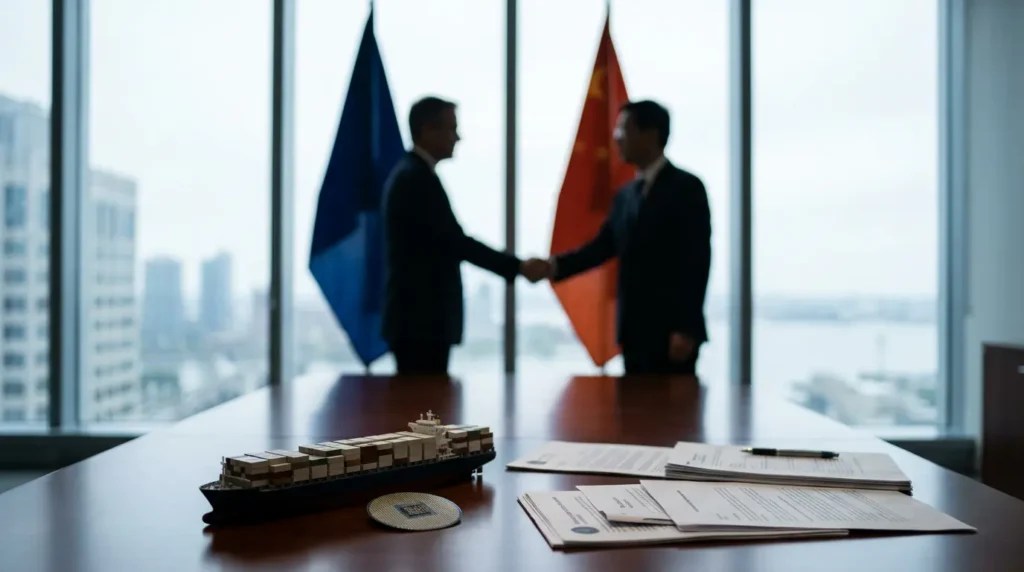

When Trump and Xi meet, the headlines will focus on tone.
Markets will react to body language. Commentators will analyze phrasing.
But the real story isn’t optics. It’s leverage accumulated before the handshake.
Over the past year, the administration has methodically tightened pressure points across trade, technology, energy, capital flows, and geopolitical alignment. At the same time, deep structural interdependencies remain…from Chinese investment in the U.S. to the hundreds of thousands of Chinese students embedded in American universities.
This is not decoupling.
It is structured rivalry under guardrails.
And it materially changes the negotiating environment.
1. Trade Has Shifted…Even If It Hasn’t Collapsed
U.S.–China trade remains massive. But direction matters more than size.
The trade deficit has narrowed from pre‑2019 peaks. Imports have diversified toward Mexico, Vietnam, India, and other “friend‑shoring” destinations. Supply chains are being re‑weighted, not dismantled.
China remains a manufacturing superpower. But it is no longer the automatic default node in global sourcing decisions.
When even 15–25% of production shifts elsewhere, leverage shifts with it.
Negotiations are rarely about absolutes. They’re about margins.
Margins have moved.
2. Technology Controls Are Structural
Export controls on advanced semiconductors and AI-enabling hardware are not symbolic measures. They are structural bottlenecks.
Advanced chips underpin:
- AI systems
- Defense platforms
- Telecommunications infrastructure
- Industrial automation
China is investing heavily to build domestic capability. But semiconductor ecosystems are complex, globally integrated, and time-intensive to replicate.
The longer restrictions persist, the more they compound.
Time, in this context, is leverage.
3. Oil: The Hidden Cost Driver
Energy is the quiet variable reshaping China’s export economics.
China imports roughly 10–11 million barrels of crude oil per day. For years, discounted Iranian crude provided cost relief. If sanctions enforcement tightens and China must pay closer to full global benchmark prices, the arithmetic changes quickly.
Even a $5per barrel increase equals roughly:
10,000,000×5×365≈$18 billion annually
At $10per barrel, the additional burden approaches $35 billion per year.
Energy feeds directly into:
- Petrochemicals
- Plastics
- Fertilizer
- Steel
- Cement
- Shipping fuel
Export sectors with thin margins feel that pressure immediately.
Meanwhile, the U.S. is now a major energy producer and LNG exporter. That asymmetry matters. As US expands, Venezuela leverage manifests and Iranian exports have yet to play out…it is a very different landscape than just months ago for China.
Energy isn’t just an inflation story.
It’s a competitiveness story.
4. Taiwan: Energy Vulnerability and the Cost of Kinetic Conflict
Now layer in Taiwan.
Any kinetic conflict would immediately expose China’s greatest vulnerability: energy dependence.
China imports roughly 70% of its crude. Much of it transits through maritime chokepoints that would be highly exposed in conflict. Even absent a formal blockade, insurance markets, shipping firms, and financial institutions would reprice risk overnight.
Modern warfare is energy-intensive. Naval deployments, air sorties, missile systems, logistics chains…all require sustained fuel access.
An oil pinch during conflict wouldn’t just hit the civilian economy. It would complicate force sustainment.
That dramatically raises the cost curve of escalation.
Conflict becomes not just a military calculation…but an energy one.
5. If Conflict Turns Kinetic, Supply Chains Break
A Taiwan conflict would not resemble tariff escalation.
It would fracture supply chains instantly.
Consider what sits in and around Taiwan:
- The world’s most advanced semiconductor manufacturing capacity
- Critical electronics nodes
- Dense East Asian shipping corridors…one of which has changed with US/Indonesia security deal
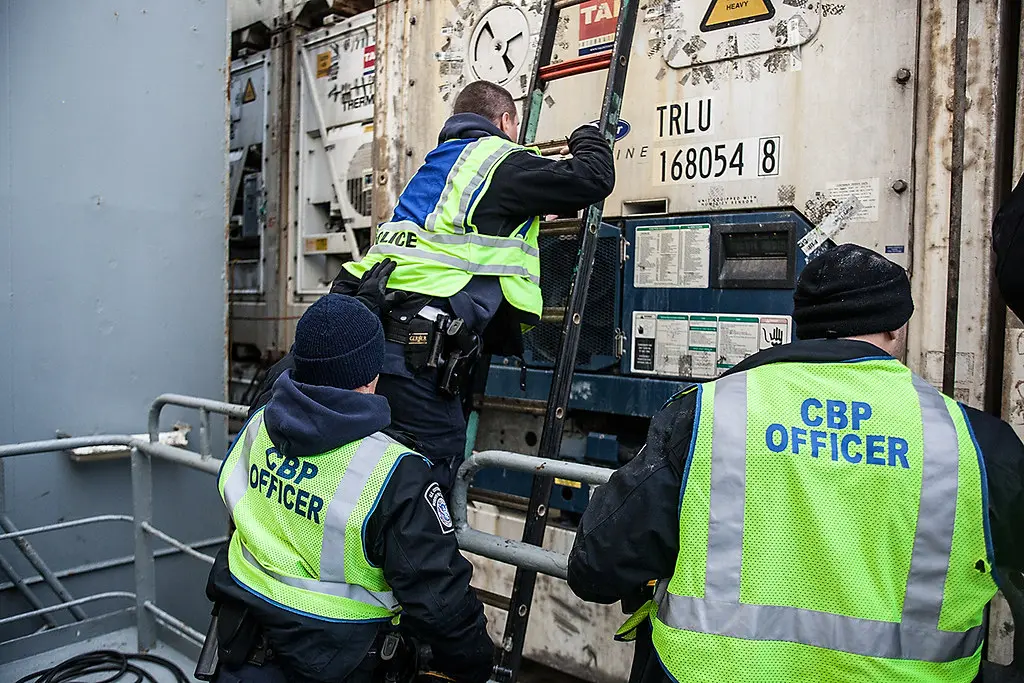
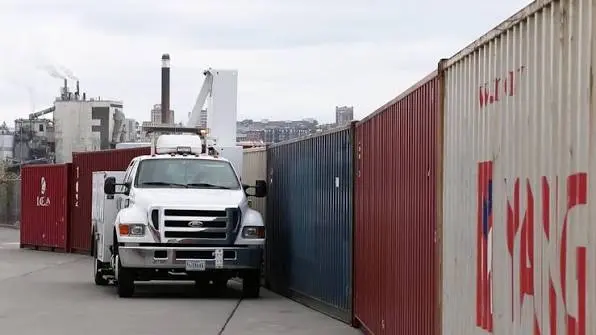
- What happens at the Chinese boarder for exports?
A kinetic event could:
- Halt advanced chip exports
- Freeze cross‑strait trade
- Spike freight and insurance rates
- Trigger capital flight
This is not gradual de‑risking.
It’s sudden rupture.
Companies that assume continuity risk underestimating tail events.
6. Curated Chinese Investment in the U.S.
Chinese investment into the U.S. has not disappeared…it has been filtered.
Large acquisitions have slowed. What remains is more curated: minority stakes, venture investments, targeted projects that pass CFIUS review.
Access to U.S. assets is now conditional.
Sensitive sectors…semiconductors, AI, critical infrastructure…face intense scrutiny.
Interdependence remains, but it is managed interdependence.
That changes negotiating leverage on both sides.
7. The Student Interdependence
Hundreds of thousands of Chinese students have historically studied in the United States, particularly in STEM programs.
For many universities, especially at the graduate level, these students represent:
- Significant tuition revenue
- Research capacity
- Cross-border innovation pipelines
A sharp decline would strain university budgets and local economies.
At the same time, national security concerns around research exposure remain.
This is one of the clearest examples of how economic interdependence complicates geopolitical hardening.
8. Panama, Iran, Russia…The Geometry of Alignment
Chinese infrastructure investments in ports and logistics hubs…including in Latin America…have drawn greater scrutiny. Strategic chokepoints like the Panama Canal are now viewed through a national security lens.
China’s relationships with Iran and Russia add further complexity:
- Iran provides discounted oil but carries sanctions risk.
- Russia offers energy alignment but operates under heavy restrictions.
If Washington were to partially stabilize relations with Moscow, Beijing’s triangulation advantage could weaken.
Great power rivalry often hinges less on ideology than on structural geometry.
Change one angle, and the entire balance shifts.
9. Don’t Expect Tariffs to Fall to Zero
Even if tone improves after a summit, structural policies are unlikely to unwind.
Export controls will remain. Investment screening will remain. Strategic-sector tariffs will likely remain.
The more realistic outcome is tariff management…not elimination.
An effective range may emerge:
- Selective relief in non-strategic consumer categories
- Maintained or strengthened barriers in semiconductors, EVs, batteries, AI, critical minerals, and defense-adjacent sectors
Tariffs are no longer temporary negotiating tools.
They are embedded guardrails.
What This Means for Your Supply Chain
This is where it becomes practical.
Whether you run procurement, logistics, finance, or strategy, the takeaway is not “decouple from China.”
It is this:
Plan for persistent friction.
- Assume tariffs remain within a structural band. Don’t model zero. Model a durable floor.
- Stress-test energy-driven cost swings. If oil spikes due to sanctions enforcement or geopolitical escalation, what happens to your suppliers’ margins?
- Evaluate Taiwan exposure explicitly. Where do advanced chips in your products originate? China’s exports more broadly as well…What’s your contingency if shipments halt for 60–90 days?
- Price in shipping volatility. Maritime insurance and freight costs can spike overnight in crisis scenarios.
- Diversify, but rationally. Total exit is rarely realistic. But 15–30% geographic diversification can materially reduce risk.
- Expect policy durability. Export controls and investment screening are now bipartisan structural tools.
The era of frictionless globalization is over.
The next phase is managed rivalry…selective interdependence within guardrails.
For supply chain leaders, this means operating in a world where:
- Energy affects geopolitics.
- Geopolitics affects freight.
- Freight affects pricing.
- Pricing affects competitiveness.
The Trump-Xi handshake will be photographed.
But your procurement strategy will be shaped by the structural forces behind it.
The real question is not whether tensions ease next quarter.
It’s whether your supply chain is built for a decade of strategic competition.
Because that’s the environment we are now operating in.
We have a methodical approach to helping companies through this time built on optionality and resilience. If you are struggling through tariff refund exposure and in putting an infrastructure in place to survive volatile times give me a call.