
For years, manufacturers blamed logistics when performance slipped.
Late inputs. Missed shipments. Margin pressure.
Often, that was justified.
In 2026, it’s no longer the full story.
Freight still matters…and in some lanes it’s tightening again with real capacity exiting..but the real constraints manufacturers face today aren’t trucks, ships, or warehouses.
They’re clearance speed, capital exposure, landed cost precision, and risk discipline.
And misdiagnosing the bottleneck is becoming expensive.
Import Dependence Never Actually Went Away
Despite years of reshoring headlines, most U.S. manufacturers remain deeply import‑dependent….up to 70% of domestic manufacturing.
For many, a majority of:
- Components
- Sub‑assemblies
- Raw materials
- Tooling and equipment
Still move through international supply chains.
What changed is not the dependency.
It’s the environment those inputs move through:
- Higher enforcement intensity
- More documentation scrutiny
- Longer dwell times
- Slower post‑entry resolution
Manufacturing risk now accumulates quietly between movement and monetization.
Yes, Capacity Is Tightening…But That’s Not the Core Constraint
Freight refusals are rising in parts of truckload and select lanes.
Routing guides fail more often. Carriers are more selective. Reliability feels uneven.
But this isn’t a demand boom.
It’s supply‑side tightening:
- Carrier and driver depletion after a prolonged downturn
- Weakened balance sheets
- No tolerance for underpriced, high‑friction freight
Capacity hasn’t disappeared.
It’s become selective.
Freight still moves…until risk shows up.
And increasingly, the delay happens before or after transportation, not during it.
The Real Bottleneck Is What Happens Around the Move
Most manufacturers can still:
- Secure transportation at a price
- Book ocean space
- Move goods physically
What’s harder now:
- Clearing customs predictably
- Managing duty exposure
- Handling post‑entry corrections
- Converting inventory into cash on schedule
Even when freight arrives on time, clearance and post‑entry work often set the pace of production and billing.
Compliance Is Now a Throughput Variable
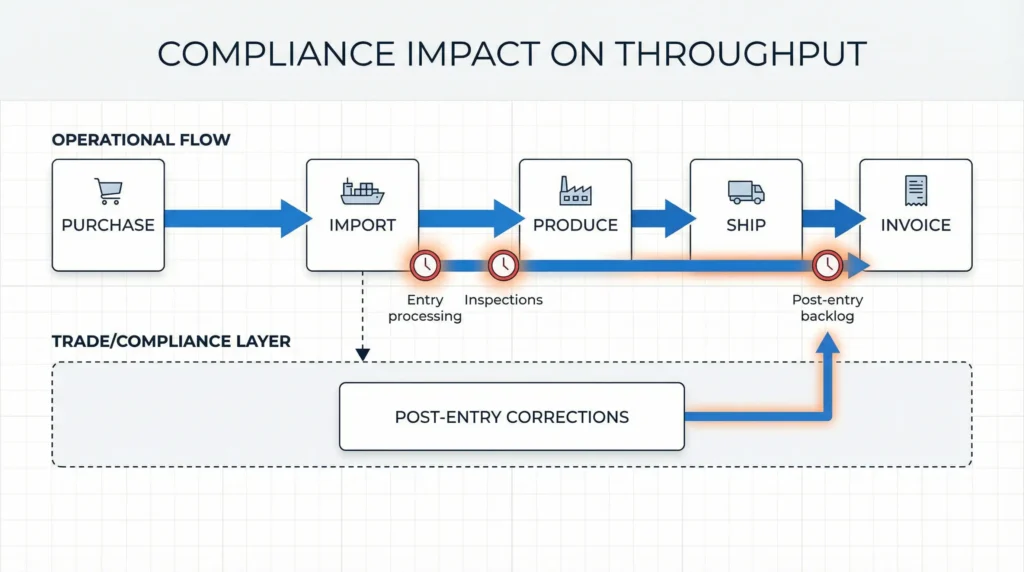
Compliance used to live in the back office….no more.
In 2026, it affects output.
Trade rules are:
- More detailed
- More actively enforced
- More expensive to get wrong
Customs brokers are under growing strain:
- Slower entry processing
- Higher scrutiny per filing
- Increasing review rates
But the real pressure point forming is on the refund side.
IEEPA‑related duties and other trade actions are creating significant refund and post‑entry correction volume. When duty structures shift, overpayments surface…and manufacturers pursue recovery. Assuming the refunds come…
That refund work is:
- Labor‑intensive
- Poorly compensated
- Technically complex
- Backlog‑prone
IEEPA‑driven refund activity alone has the potential to put unprecedented operational pressure on customs brokers.
The result is a compounding effect:
- Entries take longer
- Refund queues grow
- Post‑entry corrections expand
- Cargo release timing becomes less predictable
- Cash conversion cycles stretch
This is how compliance becomes a production constraint.
Inventory Is No Longer a Buffer… It’s a Capital Position
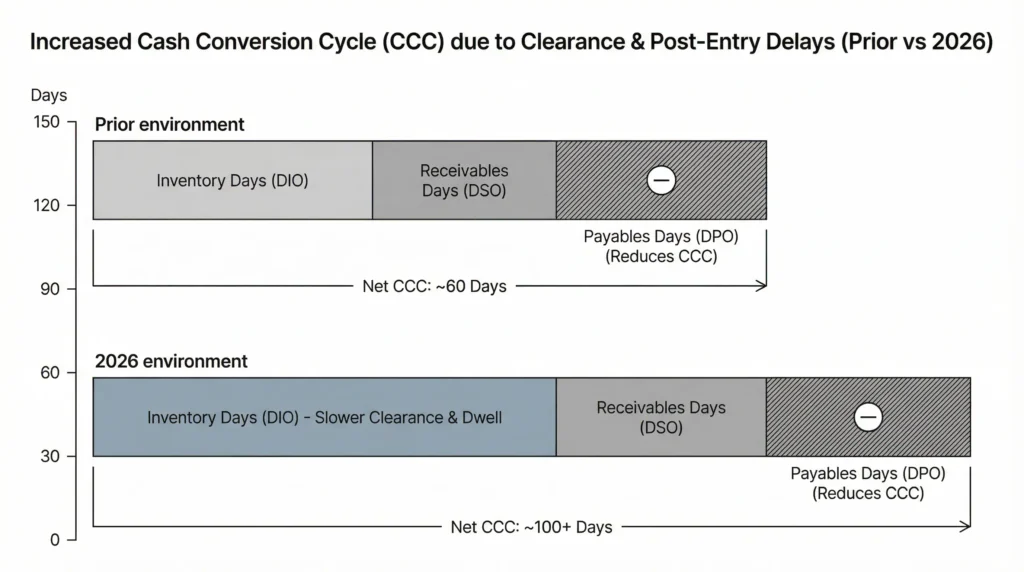
Inventory once protected service levels.
Now it concentrates exposure.
Longer dwell and slower clearance mean:
- Higher carrying costs
- More working capital tied up
- Greater risk if demand shifts
- Less flexibility under stress
Inventory that doesn’t convert quickly isn’t neutral.
It’s capital trapped in motion.
Manufacturers gaining leverage treat inventory as:
- A financial position
- Sized to cash velocity, not just forecast optimism
- Managed with clearance timing and total timing in mind
Your Sourcing Organization Must Get Exceptionally Good at Landed Cost
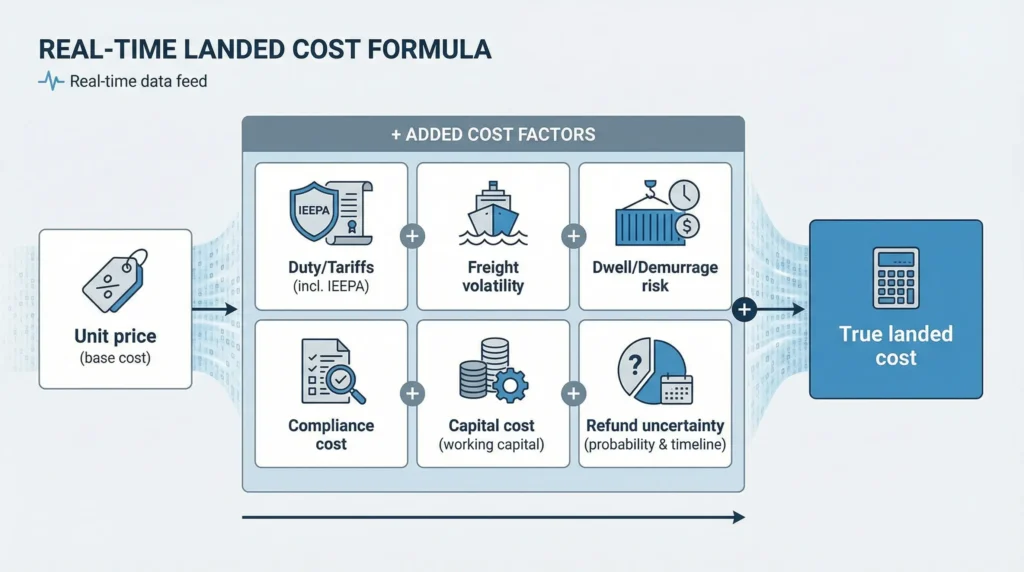
In a world of:
- Tariffs
- IEEPA‑related duties
- Variable enforcement
- Refund uncertainty
- Freight volatility
- Capital costs
“Unit price” is almost meaningless.
Competitive advantage now depends on accurate landed cost calculation…in real time.
That means sourcing teams must:
- Model duty exposure precisely
- Account for enforcement risk
- Factor in dwell and demurrage probability
- Include capital cost in inventory assumptions
- Understand refund likelihood and timeline
Landed cost isn’t just procurement math anymore and to few know how to do it in real time.
It’s strategic risk modeling.
Manufacturers that under‑calculate landed cost don’t just lose margin.
They misallocate capital.
Freight Rates Down Does Not Mean Costs Down
Some freight lanes have softened.
That does not mean the system got cheaper.
Labor hasn’t reset. Capital hasn’t gotten cheaper. Compliance hasn’t simplified. Refund timelines haven’t shortened.
When pricing assumes freight softness equals structural relief, margin compression follows.
Disciplined manufacturers:
- Price complexity explicitly
- Avoid cross‑subsidizing high‑friction SKUs
- Align contracts with true landed cost volatility
The True Constraint: Working Capital Capacity
Factories don’t stall because trucks vanish.
They slow when:
- Inventory doesn’t convert
- Refunds sit unresolved
- Receivables stretch
- Duty exposure grows
- Credit pressure compounds
In 2026, the binding constraint for many manufacturers won’t be capacity.
It will be how much capital the system can absorb without stress.
That’s a finance‑operations problem…not a transportation problem.
What Disciplined Manufacturers Are Doing Differently
They are:
- Shortening sourcing and procurement cycles
- Stress‑testing duty and refund exposure
- Monitoring clearance and post‑entry timelines as KPIs
- Integrating trade, finance, and operations decisions
- Modeling landed cost dynamically, not annually
- Implementing tariff mitigation strategies
They assume volatility is structural…not temporary.
Bottom Line
Yes…parts of freight are tightening. Yes…refusals are increasing.
But logistics itself isn’t the primary constraint for manufacturers anymore.
Clearance speed, IEEPA‑driven refund pressure, landed cost precision, and working capital discipline are.
Manufacturers who:
- Treat compliance as a throughput variable
- Prepare for unprecedented broker strain and build relationships accordingly
- Build sourcing teams fluent in landed cost risk
- Manage capital deliberately
Will outperform…even in a flat demand environment.
Those who misidentify the bottleneck will stay operationally busy.
Until the balance sheet tightens first.
I help companies small and large on mitigating tariff exposure and broader supply chain strategies…taking actionable steps to give you greater confidence on a logical path forward.