

🔥 The $2+ Trillion Reality Check: Why Every Economic Prediction About Tariffs Was Dead Wrong
Six months into the new trade era, we’re not just witnessing successful tariff policy – we’re seeing the largest manufacturing investment wave in American history. Over $2 trillion in projected reshoring commitments based on public and private forecasts represents 4x the Marshall Plan (inflation-adjusted) and the first time since the 1950s that industrial investment is outpacing financial markets.
What the Experts Predicted vs. What Actually Happened:
❌ Prediction: “Tariffs will devastate the economy”
✅ Reality: First budget surplus since 2017 – $27 billion in June alone + $2T+ investment tsunami
❌ Prediction: “Tariff revenue will be minimal”
✅ Reality: Preliminary estimates show tariff collections hit $113 billion year-to-date, up 86% from last year
❌ Prediction: “This will trigger immediate recession”
✅ Reality: Historic industrial renaissance – companies committing unprecedented capital to US manufacturing
❌ Prediction: “No one will actually reshore production”
✅ Reality: Apple ($430B), Intel ($100B+), billions in commitments across pharma leaders driving massive investment wave
The Numbers Don’t Lie:
• June tariff revenue: Record monthly collections, possibly triple prior year levels
• First time customs duties topped $100 billion in a fiscal year
• Trade duties now represent nearly 5% of total federal income
• $2+ trillion in projected manufacturing commitments – largest since WWII
• Treasury projects $300 billion tariff revenue by year-end
Smart Money’s Moving Now – Geographic Winners:
Mexico: The clear champion with $4.50/hr labor costs vs China’s $6.50/hr, plus USMCA tariff-free access and 48-72 hour truck delivery to US markets. Foreign investment up 35% in 2024.
Vietnam: Lowest costs at $2.73/hr, already negotiated 20% baseline tariff deal, rapidly climbing from garments to electronics.
India: Long-term play with strong tech/pharma workforce but bureaucratic challenges.
Industries Reshoring NOW vs. Nearshoring:
🏭 Full US Reshoring (High-tech, low labor %) – $2+ Trillion Investment Wave:
• Semiconductors: $450B committed (TSMC, Intel, Samsung), 28% of global production by 2030
• Pharmaceuticals: Billions in new commitments across industry leaders
• Clean Energy/EVs: Ford, GM, Tesla gigafactories part of $500B+ green transition
• Advanced Manufacturing: Apple’s $430B domestic commitment leading tech reshoring
• Infrastructure/Defense: Massive federal + private investment in critical supply chains
The Math Behind the Movement: Over $2 trillion in projected reshoring commitments represents the largest manufacturing investment wave in US history – 4x larger than the original Marshall Plan (inflation-adjusted). This isn’t just tariff policy working; it’s industrial renaissance driven by:
- Tax incentives from CHIPS Act, IRA, and extended Trump tax cuts
- National security imperatives in critical technologies
- Automation closing the labor cost gap
- Supply chain resilience worth the premium
🌎 Nearshoring to Mexico/Vietnam (High labor but tariff-sensitive):
• Basic Electronics: Cost differential still favors offshore+tariff
• Textiles: All but premium technical fabrics
• Consumer Goods: Anything labor-intensive shifts but doesn’t reshore
• Automotive Components: Mexico integration too deep to unwind
Where Tariffs Are Headed:
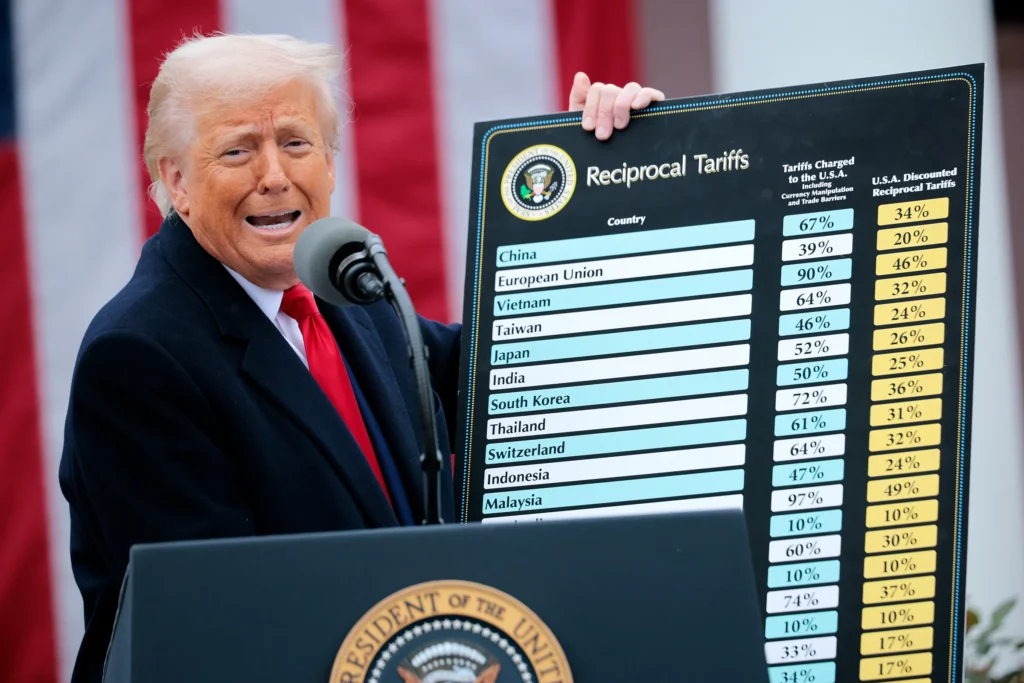
Current Status: Effective tariff rate estimated in the 15-20% range – highest since 1910
My Prediction for Final Levels:
• Baseline “Reciprocal” Rate: 15-20% for most countries (as Trump hinted)
• Strategic Partners: 10% (like current UK deal)
• Major Economies: 25-30% (Japan, South Korea, EU without deals)
• China: Likely settles at 30-40% long-term
• Non-Compliant Countries: 40%+ (as leverage)
The Smart Money’s Bet: Treasury Secretary Bessent’s $300 billion projection suggests we’re only halfway to peak revenue. Combined with $2+ trillion in projected reshoring investment commitments, we’re witnessing the largest industrial realignment since WWII.
I predict:
• 25-30% average effective rate by end-2025
• $400-500 billion annual tariff revenue by 2026
• Tariffs funding nearly 5% of federal budget permanently
• Historic manufacturing renaissance – first time since 1950s that industrial investment outpaces financial markets
Trump’s Core Economic Tenets – Mission Accomplished:
1. Deficit Reduction ✅ From chronic deficits to $27B June surplus. Tariff revenue ($300B+ projected annually) fundamentally changes federal math. First time trade policy directly funds government operations at scale since the 1920s.
2. Job Creation & Reindustrialization ✅ $2+ trillion in projected manufacturing commitments represents the largest jobs program in US history. Semiconductor fabs, pharma plants, EV gigafactories – these aren’t service jobs, they’re high-paying industrial positions with multiplier effects. Manufacturing employment heading back toward 15+ million from current 13 million.
The Labor Reality Check: Already 5 million open manufacturing positions can’t be filled, with 7 million Americans choosing to stay out of the workforce entirely. The challenge isn’t creating jobs – it’s filling them. This reshoring wave will force fundamental workforce policy changes: immigration reform for skilled trades, apprenticeship programs, and potentially ending policies that incentivize non-participation. The jobs are there; now we need workers willing to take them.
3. Protecting the Dollar’s Global Position ✅ Here’s the genius most miss: Tariffs as economic statecraft. Instead of financial sanctions that push countries toward CBDC alternatives, tariffs force trade settlement in dollars while generating revenue. Every tariff payment strengthens dollar demand. Countries can’t “sanctions-proof” their way out of tariffs like they can with banking restrictions.
4. Trade Balance Rebalancing ✅ $1.2 trillion goods deficit becomes manageable when domestic production replaces imports. Mexico and Vietnam benefit, but within dollar-denominated trade frameworks. China’s tariffs force supply chain diversification while keeping trade in US currency systems.
The Dollar Defense Strategy: Traditional sanctions pushed Russia, China, Iran toward yuan/CBDC alternatives. Tariffs do the opposite – they require dollar payments to access US markets. Every company paying 25% tariffs is strengthening dollar dominance while funding US industrial capacity. It’s economic jujitsu: using trade pressure to reinforce monetary hegemony rather than undermining it.
This isn’t just trade policy – it’s grand strategy. Reindustrialize America, fund the government, create jobs, AND strengthen the dollar’s global position simultaneously. While Trump’s negotiation strategy is best described as unconventional and creates disruption, the end game is working.
What This Means for Business: The tariff model is now permanently baked into federal budgeting, while $2T+ in private investment commitments signal fundamental economic restructuring. Companies should plan for: • Stable, predictable rates creating long-term investment certainty • Competitive advantages for domestic/nearshore production • Supply chain regionalization around North America and trusted partners
⚡ DECISIONS NEEDED NOW – Company Action Matrix:
Immediate (0-6 months): • Audit supply chains – Map every supplier’s country risk and tariff exposure • Lock in Mexico capacity – Industrial real estate and manufacturing partnerships before everyone else • Secure Vietnam relationships – Establish backup suppliers while capacity exists • Front-load inventory strategically in bonded warehouses for high-tariff items
Medium-term (6-18 months): • Automate to reshore – Only viable reshoring strategy for most industries • Diversify sourcing – “China+1” becomes “China+3” strategy • Renegotiate contracts – Build tariff escalation clauses into supplier agreements
The Bottom Line: While economists predicted disaster, we got the first June budget surplus since Trump’s first term. The “economic chaos” turned into record-breaking revenue that’s helping shore up government finances. Overarching there doesn’t appear to be many economic storm clouds on the horizon…especially given the supply side shot from the big beautiful bill. Capex investments the highest since 97 and if that translates to middle class wages we are off to the races.
But the real winners will be companies who recognize this isn’t temporary policy – it’s permanent realignment. Mexico and Vietnam are the new manufacturing centers, while only high-tech industries with automation potential truly reshore to the US.
The pundits who insisted this was “economic vandalism” need a reality check. Sometimes bold policy actually works – and creates massive opportunities for those who move first.
Your supply chain strategy today determines your competitive position tomorrow. What’s your move?
Not sure of your short term or long term moves? Reach out to me for an assessment and next steps….