
This article is part of a multi-part series designed to help business leaders navigate the evolving tariff landscape with strategic clarity and operational resilience.
We’re well past theory now. The Trump administration has shifted from rhetoric to execution, unveiling a structured, multi-pronged trade strategy aimed at reshaping how countries access the U.S. market—and how businesses think about global supply chains.
This isn’t an improvisation. It’s an emerging doctrine—and it has an end game.
The New Negotiation Playbook
Unlike the first Trump term’s incrementalism, the current approach centers on:
- Broad, multi-country tariff announcements
- A 90-day pause before implementation to trigger movement
- Simultaneous bilateral negotiations
- Publicly defined performance metrics (e.g., trade deficits, IP enforcement)
This is pressure-first diplomacy—designed to maximize leverage early, then reward response.
The “Letter Strategy” and Three-Bucket Diplomacy
Formal letters to trading partners are now part of the playbook. These communications assign each country specific tariff treatment, since we don’t have time to cut 150 deals all at once—without explicitly invoking the “Preferred / Conditional / Strategic Competitor” framework, though it clearly underpins the policy.
What’s new here:
- Each country is officially notified of its trade status
- Domestic pressure builds for those facing penalties
- A competitive dynamic emerges—nations begin jockeying for better terms
Early signal: India quietly dropped tariffs on key U.S. products ahead of formal designation—an acknowledgment that the strategy works. It is possible this is where the administration is hoping trading partners land making final tariff designation easier on the administration and moving the process along much quicker.
The Trump Trade Doctrine: Seven Key Levers
The administration’s evolving doctrine appears to rest on the following structural tools:
- Maximum Pressure Announcements – Broad, disruptive tariff moves reset global conversations
- Negotiation Windows with Teeth – The 90-day clock adds urgency
- Three-Bucket Classification – Relationship-based market access, considering IP, defense, and currency
- Formal Notification – Countries are told their status and treatment directly
- Parallel Bilateral Negotiations – Keeps pressure high across all fronts
- Quantifiable Success Metrics – From deficit reduction to IP enforcement
- Credible Enforcement – Tariffs are imposed if results aren’t achieved
This is a move away from legacy institutions toward transactional deal-making centered on leverage and compliance. Moving well beyond what former U.S. Trade Rep Robert Lighthizer described as the trifecta of stupid…NAFTA, WTO, China’s PNTR status.
Reindustrialization: Yes, But Not How You Think
You’ve heard the rhetoric: 5 million jobs and 90,000 factories coming back.
But that’s not what reindustrialization actually looks like under this policy.
What’s really returning are:
- Strategic sectors: semiconductors, pharma, advanced materials, energy infrastructure
- Tech-heavy operations with limited headcount
- Automated and capital-intensive facilities
- Supply chains redesigned for security, not just cost
And what’s not returning…lets get real
- Garment production
- Toys and footwear
- Large-scale low-wage assembly operations…sorry not IPhones either
As one strategist noted: “This isn’t a Rust Belt revival. It’s a reset for sectors that matter in a conflict economy.”
The End Game Hypothesis
The doctrine points toward something more enduring than tariffs:
1. Strategic Trade Realignment
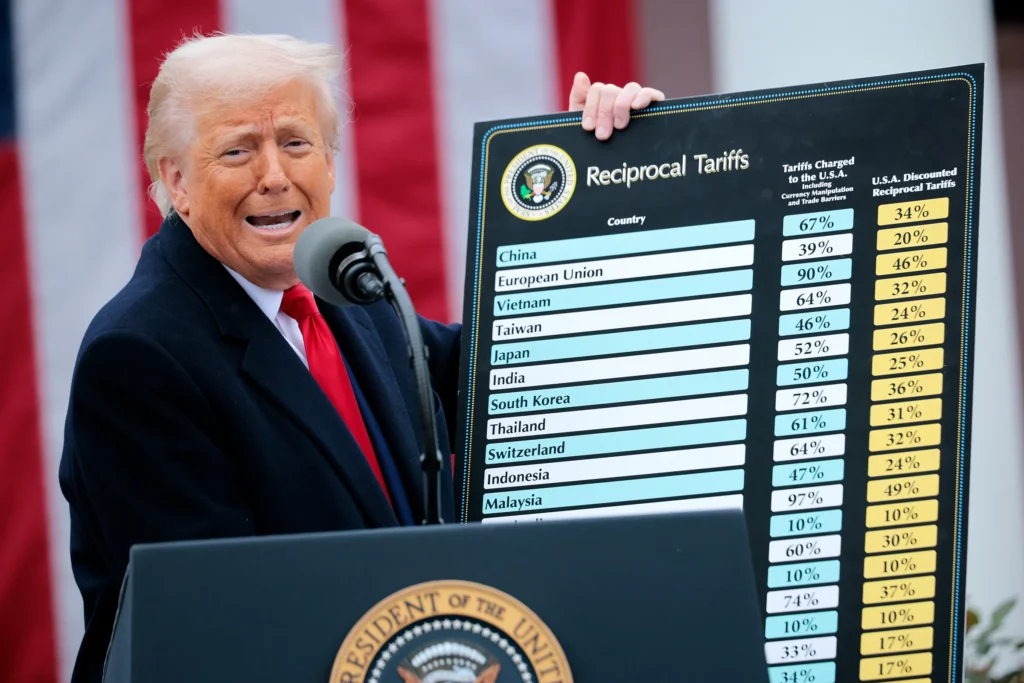
Tariffs are going to be part of our future—they’re tools to rewire global trade flows to serve U.S. interests. I think it is safe to assume everyone will be at one of the following levels…10% minimum, higher reciprocal, or highest retaliatory. Movement between them will also be possible over time.
2. Relationship-Based Market Access
Nations earn or lose access based on alignment with U.S. strategic priorities—not just trade deficits.
3. Currency Strategy: The Dollar vs. BRICS
With BRICS nations discussing a commodity-backed alternative currency, dollar dominance is being challenged. But here’s the catch:
- In 1971, the U.S. left the gold standard because there wasn’t enough gold to support the volume of dollars needed for global trade
- Any BRICS currency would face the same constraint—scaling a gold-backed system is nearly impossible
- Add in decades of financial infrastructure, legal frameworks, and global liquidity—and the dollar still wins on trust and utility
- Expect the U.S. to use fewer financial sanctions moving forward as many argue this is part of what has motivated BRICS nations
The administration may allow some strategic dollar depreciation to support exports—but the end goal is preserving reserve status while rebuilding industry.
Threading that needle—letting the dollar weaken just enough to boost competitiveness without undermining its reserve currency status—may be the ultimate balancing act. We’ll see if they can pull it off!
4. A “Mar-a-Lago Accord”?
Some believe the administration may ultimately pursue a Bretton Woods-style agreement—a new framework for global trade that integrates defense, supply chain security, and currency alignment. Call it a “Mar-a-Lago Accord.”
Just as the original Bretton Woods reshaped economics after WWII, this could formalize the shift away from post-Cold War free trade norms.
What This Means for Business
This isn’t policy whiplash—it’s a permanent shift in how America approaches trade.
Expect:
- Industry-specific protections and incentives
- Country-by-country treatment, not global rules
- Trade policy intertwined with energy, currency, and national security
- Unpredictability that rewards optionality and strategic foresight
Final Thoughts
In Part 11, we’ll bring it all together:
- What smart companies are doing now
- What resilience actually looks like under a volatile trade regime
- And how to prepare your business for a world where tariffs are no longer a temporary disruption—but a structural feature of global commerce
Are you still waiting for clarity—or building to lead in the new global order? Are you ready to move beyond the basics?