
The debate is over.
The updated Monroe Doctrine is no longer rhetorical. It is operational.
The apprehension of Nicolás Maduro marks the first unmistakable enforcement action of the doctrine and confirms how the United States now intends to project power in 2026: through leverage, not consensus.
Military action, economic controls, and supply-chain restructuring are no longer separate tools. They are part of the same system.
From Doctrine to Enforcement
For much of 2025, analysts questioned whether the Trump Corollary to the Monroe Doctrine was symbolic or actionable.
That question has now been answered.
The Maduro apprehension represents a decisive shift from:
• sanctions → enforcement
• deterrence → denial
• influence → control
The message is unmistakable: foreign rival powers will not be allowed to anchor political, military, or economic leverage in the Western Hemisphere.
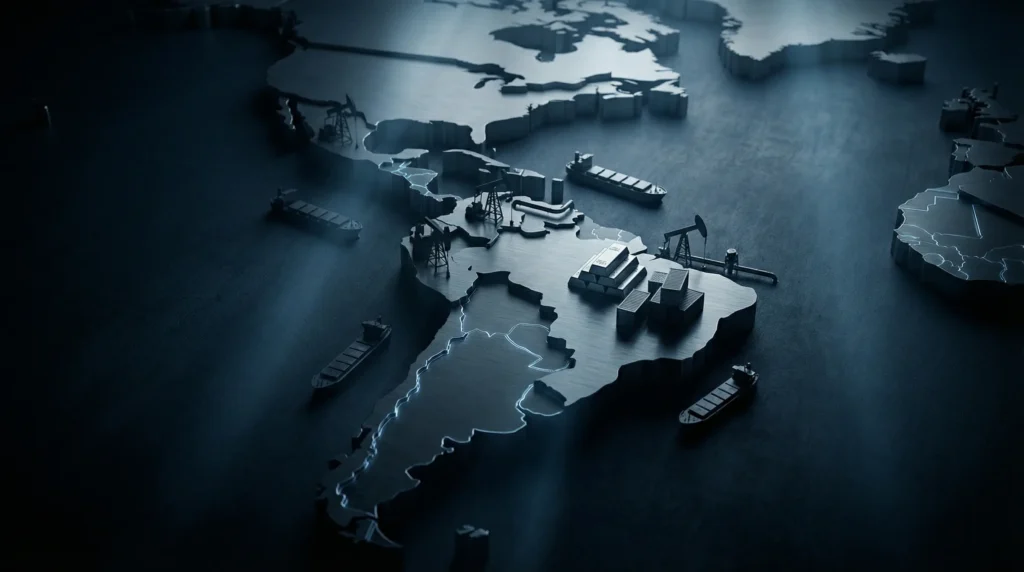
This is Monroe Doctrine logic, updated for a world where power flows through markets and materials as much as through force.
Why Venezuela Was the Test Case
Venezuela was not chosen at random.
It sat at the intersection of:
• Chinese energy finance
• Russian intelligence presence
• BRICS-aligned resource flows
• Caribbean logistics routes
Under the updated doctrine, this was not merely a failed-state issue. It was a leverage problem.
Once political control was addressed, attention shifted immediately to economic control: energy assets, metals, logistics corridors, and financial channels.
That sequence matters.
This was never just about oil or narcotics. It was about denying rivals strategic footholds in the hemisphere.
The Silver Signal: Leverage Moves Before Force
One of the least discussed, and most revealing, developments occurred before kinetic action.
There were strong indications that Chinese-linked entities accelerated the removal and repositioning of silver assets tied to Venezuelan supply chains in advance of U.S. action.
That behavior matters.
Strategic actors do not rush to secure commodities unless they anticipate disruption.
Silver is not symbolic. It is industrial, financial, and strategic, embedded in:
• energy systems
• electronics
• defense applications
• financial hedging and settlement
This was not panic. It was anticipation.
Export Controls: Silver Joins the Leverage Stack
Almost in parallel, silver began appearing in export-control and scrutiny discussions tied to China, signaling that it is no longer viewed as a neutral commodity.
This follows a familiar pattern:
• rare earths
• gallium and germanium
• advanced chips
• energy-technology inputs
Silver’s inclusion reflects a broader truth: control of industrial metals equals control of downstream capacity.
This is not about trade balances. It is about denial under pressure.
The Rare Earth Reality Behind the Doctrine
One fact underpins the urgency:
China controls roughly 90 percent of global rare-earth processing capacity.
Not mining. Processing.
That control translates directly into leverage over:
• defense manufacturing
• advanced electronics
• EVs and energy systems
• aerospace and precision components
China spent decades quietly weaponizing supply-chain chokepoints. The updated Monroe Doctrine is the U.S. response: regionalize, secure, and deny.
Supply Chains Are Now Strategic Weapons
In this framework, supply chains are no longer neutral infrastructure.
They are:
• pressure tools
• deterrence mechanisms
• escalation pathways
• bargaining chips
Factories do not shut down because of ideology. They shut down because materials do not arrive.
That is power.
And silver, like rare earths, has crossed the line from commodity to control node.
Why This Is a Structural Shift, Not a Moment
This is not about one country or one operation.
It reflects a permanent change in how power works:
• globalization created vulnerabilities
• vulnerabilities became leverage
• leverage became weaponized
The updated Monroe Doctrine is simply the geographic expression of that reality.
The Western Hemisphere is the only region where the U.S. can realistically:
• secure resources
• control processing
• defend logistics
• enforce alignment
Final Question
This moment is no longer abstract.
Supply chains are weapons.
Regionalization is defense.
Leverage is vital.
How do your supply-chain and sourcing strategies align with a world where the Monroe Doctrine has been updated and is now being enforced?
So what’s next. Greenland?
I will return next in my 2026 series to explore what this means as the doctrine expands beyond the hemisphere and reshapes global economic power.
Tariff Refund-Rights Preservation Checklist
I built a one-page checklist covering:
• liquidation tracking
• PSC timing
• protest rules
• documentation for scrutiny
• transfer pricing alignment
• weekly broker review
• economic-burden proof requirements
Download here:
https://supplychainalytics.ai/refund-rights-preservation-checklist/