
As Section 122 tariffs sunset, many are asking a familiar question:
Are we going back to normal?
The short answer: No.
What we’re seeing is not the end of tariffs. It’s the beginning of something more durable.
The shift from temporary Section 122 emergency tariffs to structured Section 301 enforcement signals a fundamental pivot in U.S. trade policy, from episodic pressure to institutionalized leverage.
This is not about a single rate increase.
It’s about architecture.
From Emergency Tool to Structural Framework
Section 122 was designed as a temporary measure. Section 301 is investigatory, deliberate, and legally grounded in the Trade Act of 1974.
That distinction matters.
Emergency tariffs create volatility. Section 301 creates precedent.
And precedent creates durability.
When tariff rates are tied to formal findings, in this case, failures to prohibit forced labor imports, they become harder to unwind politically and more defensible legally.
This feels less like a negotiation tactic. More like a recalibration of market access.
The Emergence of a 10–15% Tariff Baseline
Look closely at the rates.
10%. 12.5%. Variable net-of-MFN structures.
Not 25%. Not 50%. Not shock-and-awe.
This is calibrated.
A 10–15% band is:
- High enough to influence sourcing decisions
- Low enough to avoid immediate inflation shock
- Broad enough to normalize over time
- Structured enough to withstand judicial scrutiny
We may be witnessing the quiet establishment of a new tariff floor, where 0–5% becomes the exception and 10–15% becomes the cost of entry into the U.S. market.
That’s not escalation.
That’s managed trade.
The Quiet Tiering of Nations
Another under-discussed development is the geopolitical signaling embedded in these measures.
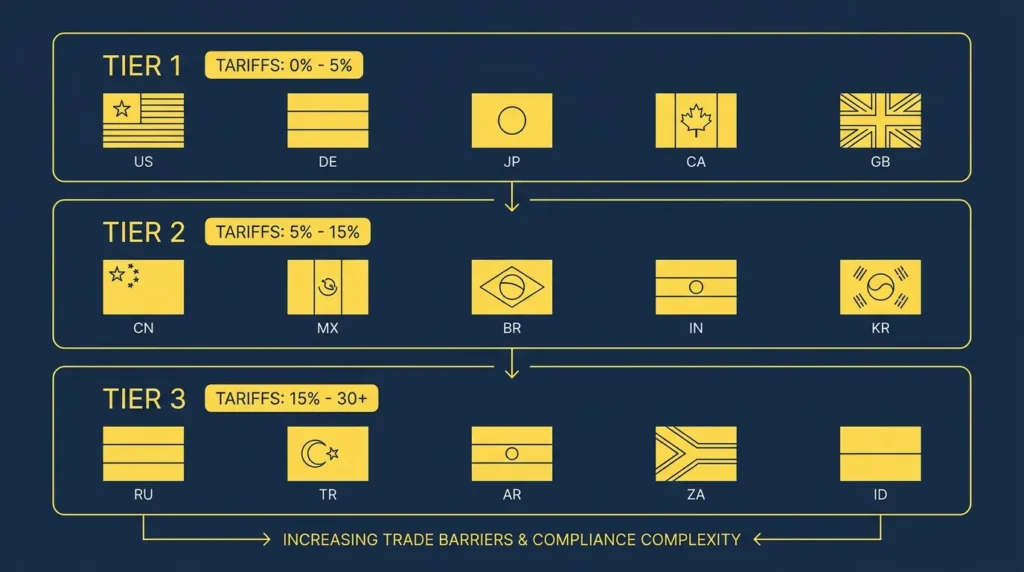
Countries are effectively being tiered:
Tier 1: Nations with forced labor prohibitions or reciprocal commitments (10%). Tier 2: Strategic allies with product-level calibration (10–12.5%). Tier 3: Economies without comparable regimes (12.5%). Maybe higher.
This is no longer binary, ally vs. adversary.
It’s graduated access.
Market entry is increasingly conditional on regulatory alignment.
Trade policy is becoming geopolitical infrastructure, with all the depth and breadth involved.
The “Big Stick / Small Stick” Strategy
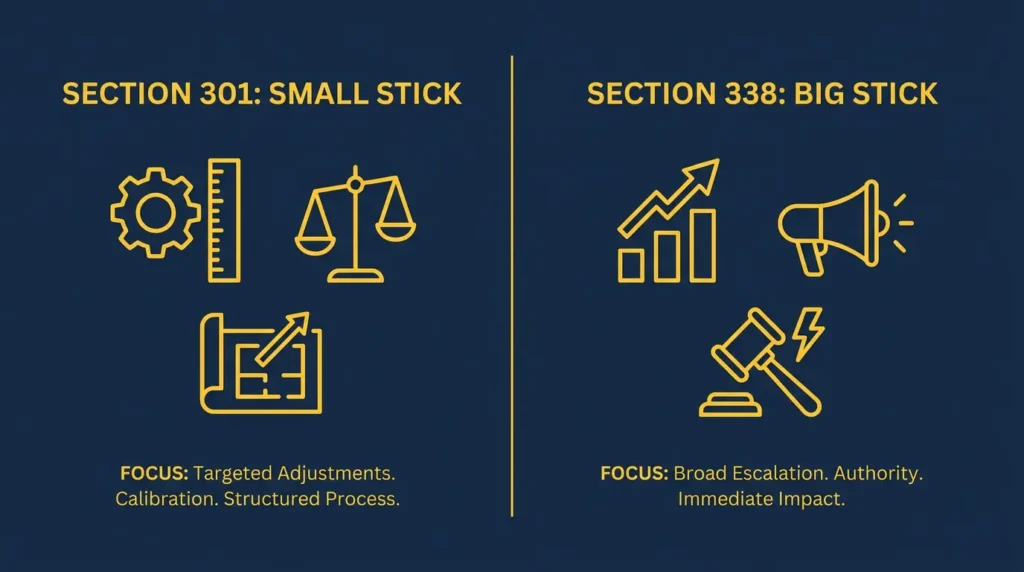
Section 301 is the operational tool.
But Section 338, rarely invoked but powerful, authorizes significantly higher tariff escalation if needed.
That’s the “big stick.”
The current 10–12.5% framework is the “small stick,” structured, durable, calibrated.
Predictable does not mean passive.
It means:
- Escalation authority exists.
- But stabilization is preferred.
- Leverage is structured, not chaotic.
This dual-track model strengthens negotiating power without constant volatility.
Bilateral Agreements May Mirror, Not Remove
A key assumption in the trade community is that bilateral agreements eliminate tariffs.
But under this emerging framework, bilateral deals may instead:
- Lock in 10% ceilings
- Provide conditional reductions
- Tie tariff treatment to compliance benchmarks
- Include snap-back provisions
In other words:
Free trade agreements may evolve into managed tariff agreements.
That is a profound shift.
The Real Story: Compliance Is Now Market Access
Here is where the conversation moves beyond rates.
Tariff exposure is no longer just a sourcing or finance issue.
It is:
- A governance issue
- A regulatory risk issue
- A reputational issue
- A board-level oversight issue
Forced labor enforcement is now directly linked to tariff treatment.
Which means compliance posture influences landed cost.
And that changes internal priorities.
The question is no longer: “Can we move production?”
It is: “Can our supply chain withstand scrutiny?”
Need a clearer picture of your supply chain exposure?
Every company faces different risks. I help leadership teams identify where cost, compliance, and operational exposure are hiding before they become expensive problems.
The Calls Are Coming
Customs enforcement is increasingly documentation-driven.
The inquiry sounds simple:
“Show us your work.”
Origin determinations. Forced labor due diligence. Classification rationale. Audit trail integrity.
Verbal assurances are irrelevant.
Process integrity is everything.
This is where many organizations are exposed, not because they are intentionally non-compliant, but because their compliance infrastructure was built for a lower-stakes environment.
That environment is gone.
Trade Compliance Infrastructure Is a Strategic Imperative
If tariffs are stabilizing in the 10–15% range and enforcement is intensifying, then compliance infrastructure becomes table stakes for your business.
That means:
- Documented and auditable processes
- Technology-enabled supply chain visibility
- Multi-tier supplier transparency
- Classification controls and origin governance
- Alignment across trade, legal, procurement, finance, and ESG
- Executive oversight
This goes well beyond broker relationships.
This is about internal architecture.
Why This Latest Round May Withstand Court Challenges
Another overlooked dimension: litigation resilience.
Calibrated tariff rates tied to formal findings are harder to characterize as arbitrary.
If courts uphold these authorities, the framework becomes even more entrenched.
Ironically, legal challenges may strengthen the durability of the regime.
And once normalized, 10–15% becomes the new baseline assumption in cost modeling.
Where Is This Heading?
If this trajectory continues, expect:
- Expansion of compliance-linked trade tools
- Environmental and digital standards incorporated into tariff regimes
- More structured country tiering
- Increased use of escalation authority (Section 338) if alignment falters
- Greater harmonization among allied blocs
This does not look like a temporary political cycle.
It looks like a redesign of how the U.S. prices market access.
The Bottom Line
We are not exiting the tariff era.
We are moving from volatility to structure.
From emergency to architecture.
From reactive trade disputes to managed, compliance-conditioned market access.
Organizations that treat this as temporary will operate defensively.
Organizations that treat compliance infrastructure as strategic capability will compete with greater confidence when enforcement calls, and those calls are coming.
The real question is not whether tariffs will remain.
It’s whether your internal systems are built for a world where they do.
Build a More Resilient Supply Chain
Whether you’re managing tariffs, trade compliance, sourcing strategy, or operational risk, I help organizations build stronger, more resilient supply chains for long-term success.